The Origin Story of Tattva
A Lifetime of Understanding the Human Mind

“Every human being deserves to be understood before they are judged.”
This simple belief became the foundation of everything that followed.
Tattva did not begin as a theory.
It did not begin in a research laboratory.
It did not begin in a counselling room.
It began with a question.

A Question That Never Left Me
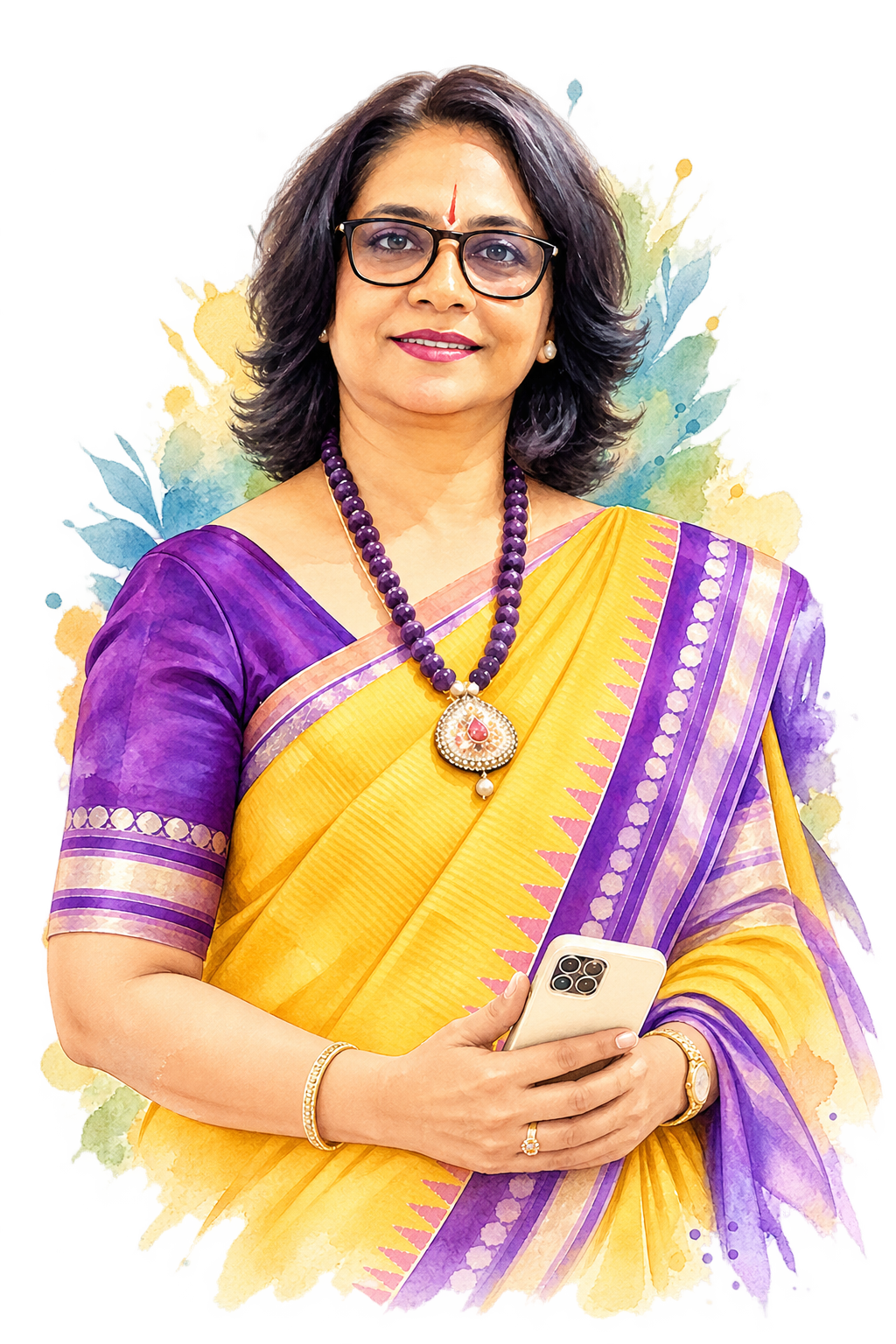
“What goes on behind the mask we wear?” This question has stayed with me since my teenage years. Long before I became a psychologist, I was simply fascinated by people. As a teenager, one of my favourite pastimes was quietly observing those around me and wondering what lay beneath the lives they presented to the world. Every person seemed to have two lives—the one others could see and the one they carried within themselves.
I often wondered why people smiled while hiding pain, why those who appeared confident sometimes struggled with insecurity, and why two people experiencing the same situation could respond in completely different ways. What fascinated me was not behaviour itself, but the invisible world behind it—the thoughts people never spoke, the emotions they struggled to express, the beliefs that shaped their choices, and the experiences that quietly influenced the way they saw themselves and others. At that age, I had no ambition to create a theory or develop a framework. I was simply searching for an answer. Looking back today, I realise that this quiet curiosity became the first seed of what would eventually become Tattva.

The Questions Grew Deeper
Years later, that same curiosity led me to study psychology. I believed psychology would help me answer the questions that had fascinated me since my teenage years. It gave me a scientific foundation for understanding the human mind—but it also led to even deeper questions. As I began working with people, one question surfaced repeatedly. Why are people so different? Why do two people raised in the same family respond differently to the same situation?
Why do some flourish through adversity while others struggle despite opportunity? Why do people think, feel, learn, love, and suffer so differently? These questions marked the beginning of a lifelong search—not simply to understand behaviour, but to understand human uniqueness. That search eventually became Tattva.
From Classroom to Reality: When Theory Met Life
Why doesn't theory fully explain people?
Years later, I chose to study psychology, believing it would help me understand the human mind. I completed my education in Bangalore, a vibrant metropolitan city that exposed me to diverse ideas, cultures, and ways of thinking.
Armed with academic knowledge and professional confidence, I moved to Kakinada, a coastal town in Andhra Pradesh, expecting to apply everything I had learned. Instead, I encountered a completely different social reality. The lifestyles, cultural values, belief systems, relationships, and ways people interpreted the world differed significantly from what I had experienced in Bangalore. I began to see that the same psychological principles often unfolded differently because they were shaped by different families, communities, traditions, and life experiences.
For the first time, I realised that the answers I had learned in classrooms were not always enough to explain the lives unfolding before me. That realization was both humbling and transformative. It made me question whether psychology, by itself, was enough to fully understand people. I realised that human behaviour cannot be understood through theory alone. It is shaped by the continuous interaction between biology, family, culture, environment, beliefs, relationships, and lived experience. That realization became the first major turning point in my journey. From that moment on, I was no longer simply applying psychology. I was learning from people.

Strategies Options and Solutions (SOS):
Where Learning Became Practice
How can people truly understand themselves?
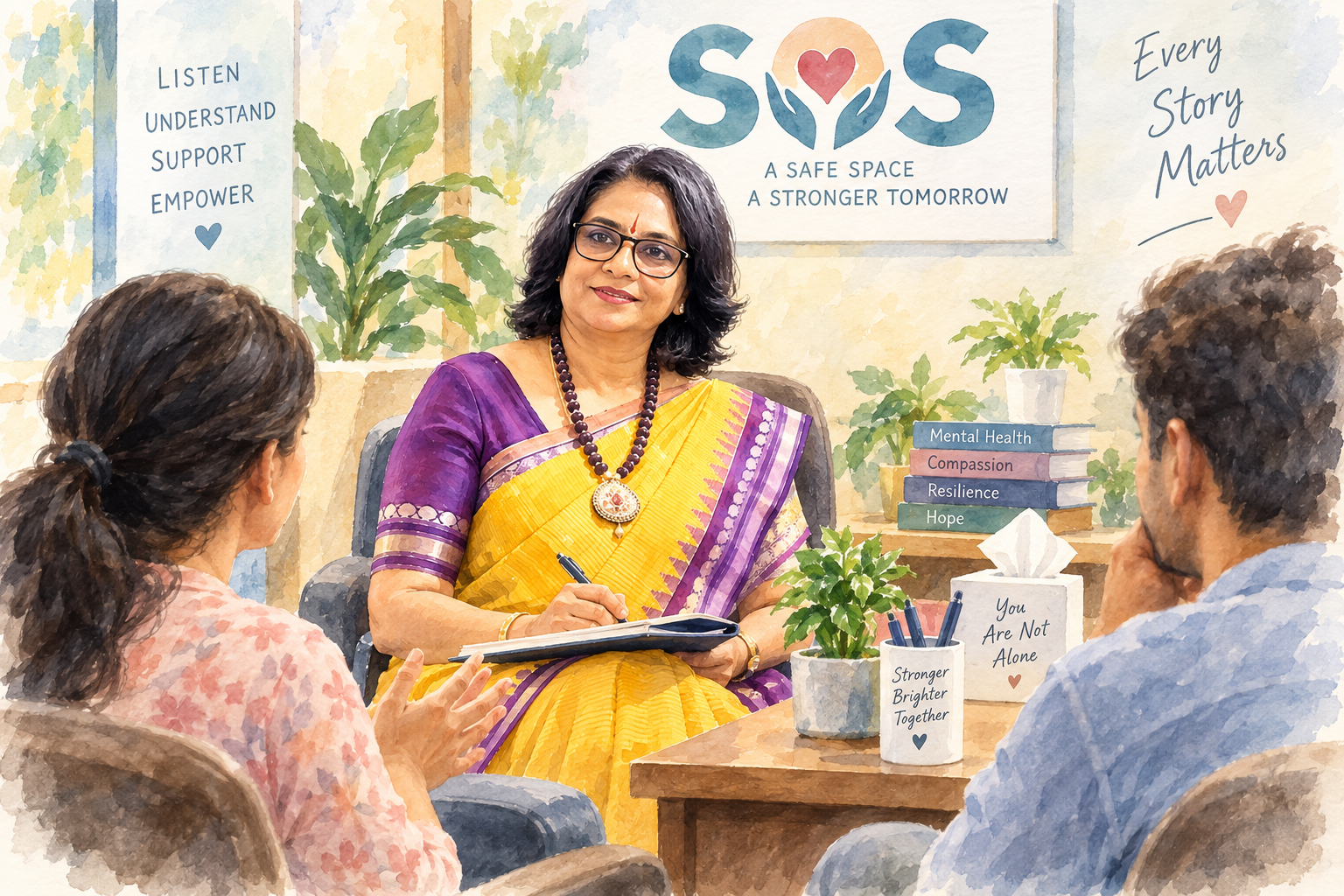
In 2002, I founded Strategies Options and Solutions (SOS), a psychological counselling and guidance centre with a simple purpose—to help individuals navigate life’s emotional, personal, educational, and relationship challenges. At the time, I believed I was building a counselling practice.
Looking back, I realise I was creating something much more significant. SOS became the place where observation, reflection, and practice came together. Every conversation deepened my understanding of the extraordinary uniqueness of human beings. Every individual who walked through its doors brought a unique story, a unique struggle, and a unique way of understanding the world. No textbook could have prepared me for the richness and complexity of real human lives.
Over the years, I had the privilege of working with people across every stage of life—children, adolescents, parents, couples, educators, professionals, and senior citizens. Their concerns varied, but one truth became increasingly clear: No two people experienced the same problem in exactly the same way. The more people I met, the more convinced I became that every individual possesses a unique way of perceiving, processing, feeling, learning, and responding to life. SOS was never just a counselling centre. It became the place where observation evolved into inquiry, inquiry evolved into research, and research gradually evolved into a new understanding of human individuality. It was here that the earliest foundations of Tattva quietly began to emerge.
Helping People See Themselves
As my counselling practice grew, I gradually realised that lasting change rarely came from advice alone. People often knew their problems. What they struggled to see were the patterns behind those problems. Rather than telling people what they should do, I began helping them visualise their own lives. During counselling sessions, I would sketch simple diagrams of relationships, conflicts, recurring behaviours, emotional patterns, and thought processes. Something remarkable began to happen. When people could see their lives from a different perspective, they often discovered answers that had been hidden in front of them all along. That experience taught me a profound lesson. People rarely needed a different life. They often needed a different way of seeing it.

When One Session Had to Matter
How can transformation begin in a single meeting?
In the early years of my practice, mental health carried enormous social stigma. Many people were reluctant to consult a psychologist.
- Some feared being recognised.
- Others believed seeking counselling was a sign of weakness.
- Many came only once.
- I realised I might never have another opportunity to help them.
- That reality transformed the way I approached counselling.
Instead of planning long therapeutic journeys, I began asking myself a different question: How can I create maximum clarity in a single session?
That question changed everything. It forced me to move beyond treating individual symptoms and begin searching for the deeper patterns that shaped how people perceived, processed, and responded to life. Without realising it, I had begun moving from counselling people to studying the architecture of the human mind. That search would eventually lead to my research and, years later, to the development of Tattva.

Education:
Understanding the Mind Through Learning
Why are people so fundamentally different? “Psychology helped me understand the mind. Education taught me how that mind learns, grows, and expresses itself.” While psychology allowed me to understand individuals, education allowed me to observe human development over time.
Working with students, teachers, parents, and educational institutions gave me an entirely different perspective on the human mind. Every classroom demonstrated something psychology had only begun to suggest—that no two individuals learn in exactly the same way.
• The same teacher. • The same lesson. • The same classroom. • Yet every student understood, interpreted, and responded differently. • Some learned through logic. • Others through experience. • Some flourished with encouragement. • Others grew through challenge. Education taught me that understanding must always come before instruction. The responsibility of an educator is not simply to transfer knowledge, but to discover the pathway through which each individual learns best. This experience transformed my understanding of both psychology and education. • Psychology explained behaviour. • Education revealed development. Together, they showed me that every human being possesses a unique way of perceiving, processing, learning, and responding to the world. During these years, I was no longer merely practising psychology or working in education. I had become a student of human behaviour.

Searching for Patterns
Years of counselling confirmed what I had sensed from the very beginning: every individual was unique. Yet beneath that uniqueness, I began noticing recurring patterns in the way people perceived, processed, learned, and responded to life. The more people I met, the more fascinated I became by these patterns. I found myself asking: “Could there be an underlying design that shapes the way each person experiences the world?” That question marked the beginning of a new phase in my journey.
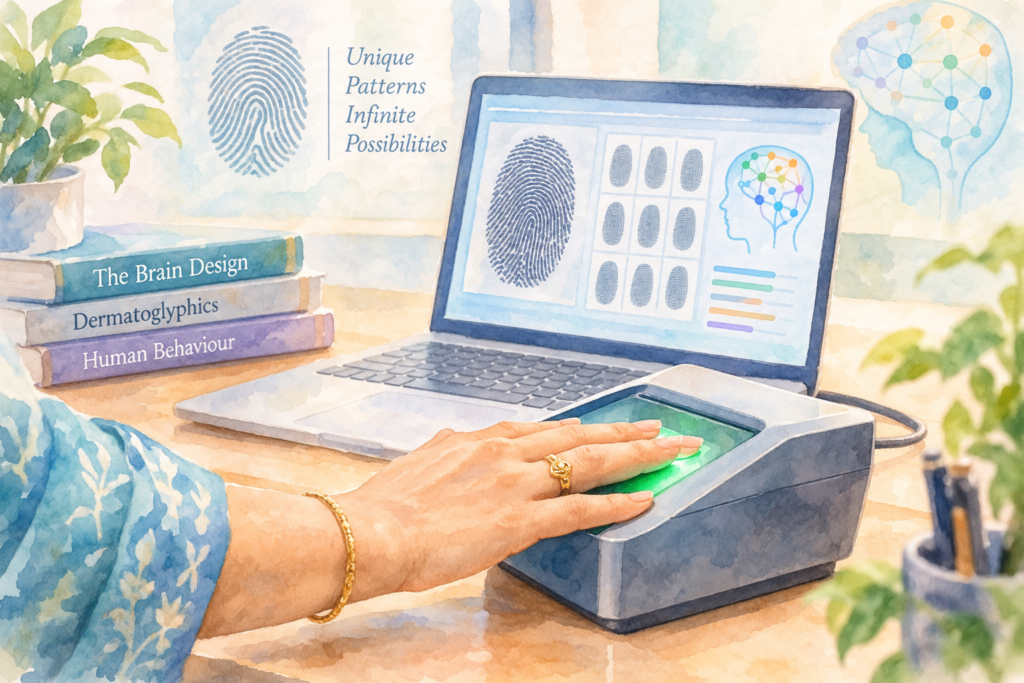
My search gradually expanded beyond psychology into neuroscience, embryology, genetics, and dermatoglyphics. I wanted to understand whether biology might offer clues to the remarkable differences I observed every day in my counselling practice. As I studied fingerprint patterns alongside years of behavioural observations, I began recognising consistent relationships that eventually formed the foundation of The Brain Design.
From Understanding People to Helping Them Understand Themselves
For me, fingerprints were never the destination. They became an objective biological starting point for understanding human individuality. The Brain Design opened a new way of understanding individuality. Yet it also revealed another challenge. Many people were uncomfortable with biometric assessments. Some had concerns about privacy. Many professionals were hesitant to accept fingerprints as part of psychological understanding. That experience led me to an important realization. The purpose was never fingerprints. The purpose was understanding people. So I asked myself another question. Could people discover themselves without beginning with biology? That question led to the development of The Inner Mind Map, a psychometric assessment created through Mind Avenues.
While The Brain Design explored biological predispositions, The Inner Mind Map invited people to participate actively in understanding their own thinking, emotions, motivations, and behavioural patterns. The journey shifted from being analysed by someone else to discovering oneself.
Beyond Psychology:
Searching for the Missing Pieces
Both The Brain Design and The Inner Mind Map deepened my understanding of human individuality. Yet another question continued to challenge me.
“Why do people with similar potential live completely different lives?”
Why does one individual flourish while another struggles despite possessing comparable abilities? I gradually realised that potential alone could never explain the human story. Life itself shapes the expression of that potential.
- Relationships
- Experiences
- Culture
- Environment
- Beliefs
- Purpose
- Choices
Alongside these, I explored philosophy, spirituality, astrology, Nakshatra traditions, and palmistry—not to replace science, but to understand how different civilizations have sought to answer the same timeless questions about human nature. Every discipline contributed another perspective. Every perspective revealed another piece of a much larger picture.

Why I Called It Tattva
Understanding ourselves does not begin by looking outside for answers.
It begins by recognising the unique design that already exists within us.
As my research evolved, I realised that I was no longer searching for another psychological model or assessment tool. I was searching for something more fundamental—the essence of what makes each human being unique.
The Sanskrit word Tattva means essence or fundamental reality. To me, it represents the essence of the human mind—the unique way in which each individual perceives, processes, learns, feels, responds, and experiences life.
My research into fingerprint patterns led me to view them as a biological window into human individuality. At the same time, my exploration of traditional knowledge systems, including palmistry, introduced the idea that fingerprints have also been regarded as carrying deeper symbolic significance.
Tattva is not simply a theory.
It is an invitation to discover the essence of who we are.
Throughout this journey, one realization became increasingly clear. I realised no discipline explained the richness and complexity of human experience. I searched for the essence. That is why I called it Tattva.
- Science explained biology.
- Psychology explained behaviour.
- Education explained learning.
- Culture shaped beliefs.
- Philosophy searched for meaning
- Spiritual traditions explored purpose.
Each discipline offered valuable insights. Yet each illuminated only one part of a much larger whole. Gradually, the questions that had guided my life changed. No longer, “What is this person’s personality?” Instead, why do we suffer? What enables people to flourish? How do we live with wisdom, purpose, and compassion?
Those questions gave birth to Tattva. Not as a replacement for psychology. Not as a replacement for biology. Not as a replacement for philosophy or spirituality. But as an integrative framework that brings together the strengths of many disciplines to understand the uniqueness of every human being. At the heart of Tattva lies a simple belief.
Every human being is unique. To truly help someone, we must first understand how they perceive, process, and respond to life. Only then can guidance become personal. Only then can empathy replace judgement. Only then can knowledge become transformation.
The Journey Continues
Can the insights of many disciplines be integrated into one framework?
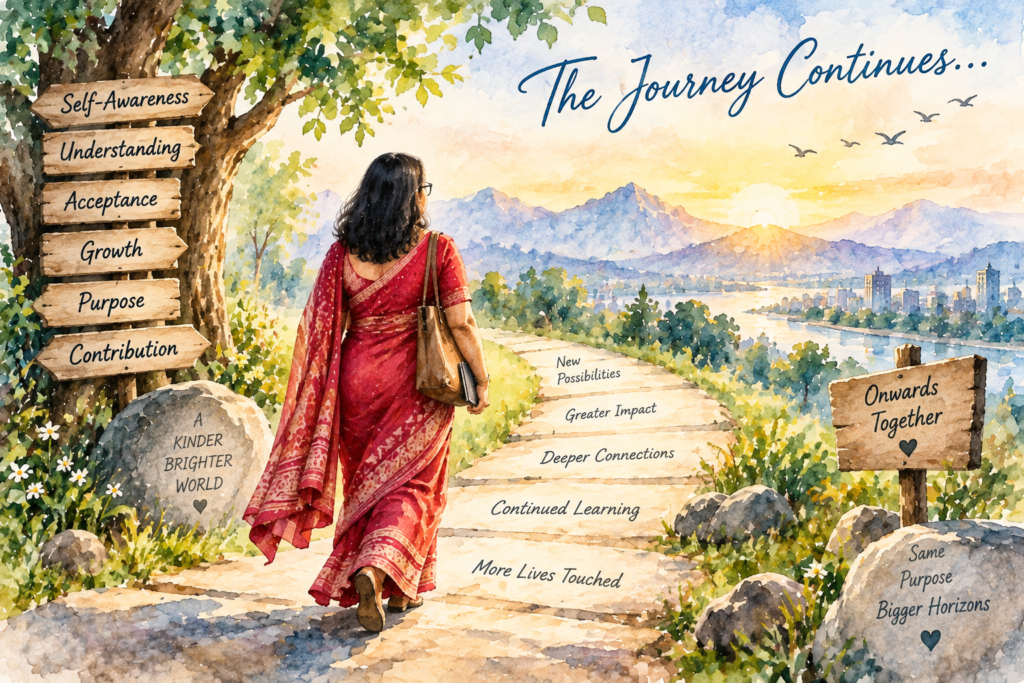
Tattva is not the destination. It is the continuation of a lifelong search. A search inspired by decades of counselling, years of research, thousands of conversations, and an enduring curiosity about the extraordinary uniqueness of the human mind. The question that first emerged in my teenage years continues to guide me today. The question that first emerged in my teenage years still guides me today.
What goes on behind the mask we wear?
Today, I believe that every step of my journey—from psychology and education to counselling, research, The Brain Design, The Inner Mind Map, and ultimately Tattva—has been an attempt to answer that one enduring question. The search continues. My hope is that Tattva will contribute to a world where people are understood before they are judged, where guidance is personalized rather than generalized, and where our differences are recognised not as weaknesses to overcome, but as the very qualities that make each of us uniquely human.